Justice Jones
A restrained modern noir crime franchise about systems that fail quietly, institutions that protect themselves, and the detective who notices when something does not add up.
Each case stands on its own, but together they trace a larger pattern: missing records, altered timelines, shared spaces, controlled narratives, and decisions made just out of view.
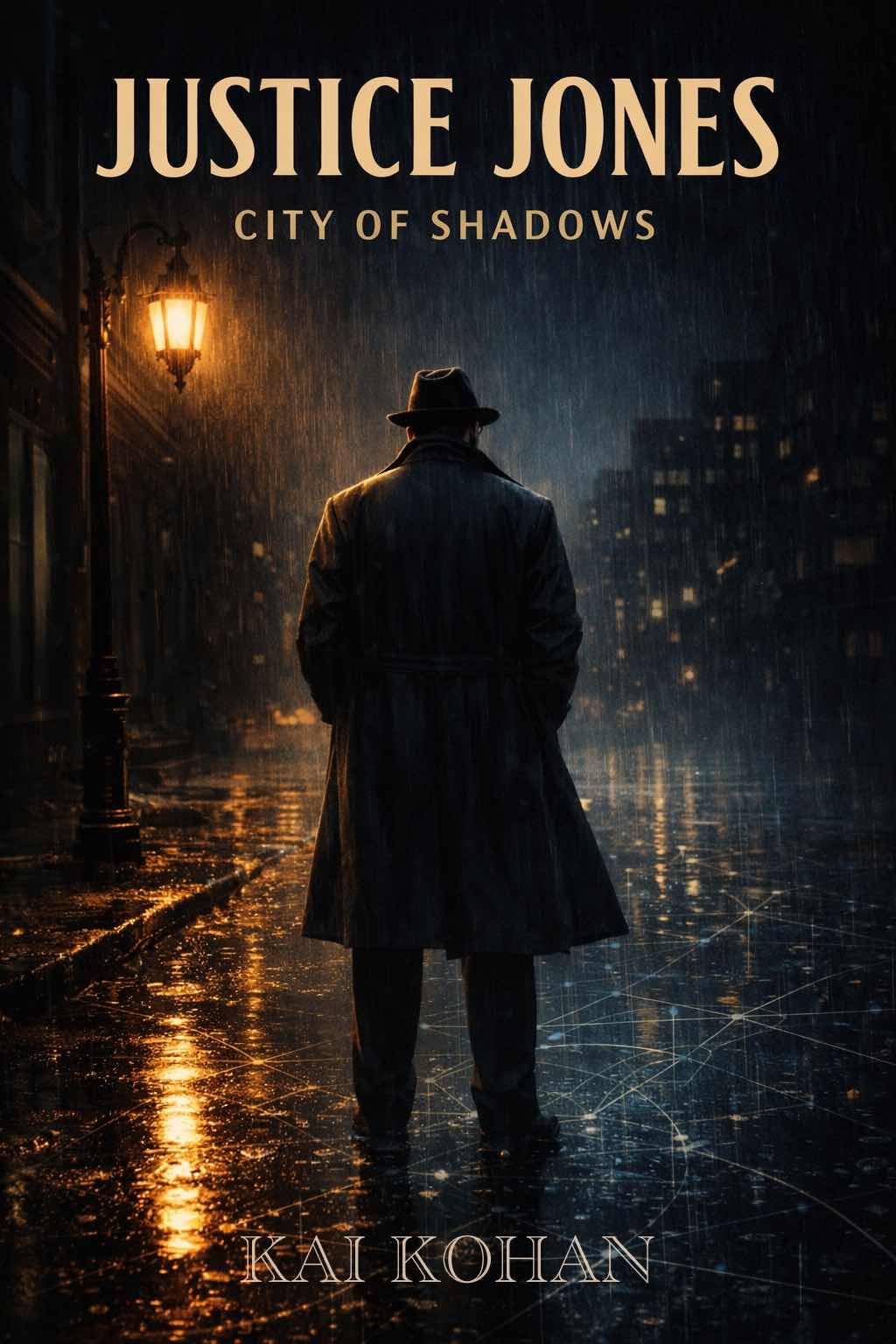
The detective follows the gaps.
Justice Jones does not chase spectacle. He follows the places where the official version thins out: missing records, misunderstood witnesses, sealed rooms, missing minutes, and the quiet decisions that become policy before anyone can object.
The first entry, City of Shadows, establishes the franchise: atmospheric, precise, institutional, and built for case-by-case expansion.
With six published investigations, the franchise now offers an established literary foundation for television or feature-film adaptation.
The Franchise Engine
Justice Jones works because the structure is repeatable without becoming formulaic: a contained case, a precise moral pressure point, and a larger institutional pattern hiding underneath.
Case-Based
Every book functions as a standalone investigation with its own emotional and procedural hook.
Serialized Pattern
Together, the cases reveal repeated institutional habits: silence, omission, delay, and self-protection.
Noir Without Noise
The stories are restrained, atmospheric, precise, and unsettling. Consequences arrive without warning.
Expandable IP
The format lends itself to novels, audio, episodic television, limited-series arcs, and selected features.
Six stories built for the screen.
The proposed television structure draws on each published case as the foundation for one episode. The exact plots, character progression, and season arc would be refined through screenplay development.
City of Shadows
An apparently routine investigation reveals missing records and contradictions in an official account, establishing Justice’s refusal to accept convenient answers.
Aphasia
A witness unable to communicate easily is dismissed by those responsible for understanding her. Justice recognizes that silence is not absence.
Negative Space
A death inside an environment without meaningful observation leads Justice into a system where accountability has been designed out of the record.
Right of Way
Questions of access, authority, and urgency create an investigation in which the rules themselves become part of the mystery.
Seventeen Minutes
A seemingly airtight timeline begins to fracture around a period of missing time that changes the meaning of everything surrounding it.
Last Call
A late-night collapse, an uncomfortable final conversation, and a carefully controlled account bring Justice face to face with another official version that cannot withstand scrutiny.
This is an illustrative adaptation architecture, not a completed screenplay or final episode-by-episode production bible.
The Case Files
Six published novels. Six distinct investigations. Two phases of Justice Jones’s career. Together they provide the underlying material for multiple possible screen formats.
City of Shadows
When routine explanations stop adding up, Justice follows the silence: missing records, altered timelines, and a truth filed neatly out of sight.
Buy on Amazon →
Aphasia
A witness who cannot speak is misunderstood by everyone except the detective who knows silence is not the same thing as absence.
Buy on Amazon →
Negative Space
A death in a room designed not to be observed reveals a system built to erase accountability before it can even be assigned.
Buy on Amazon →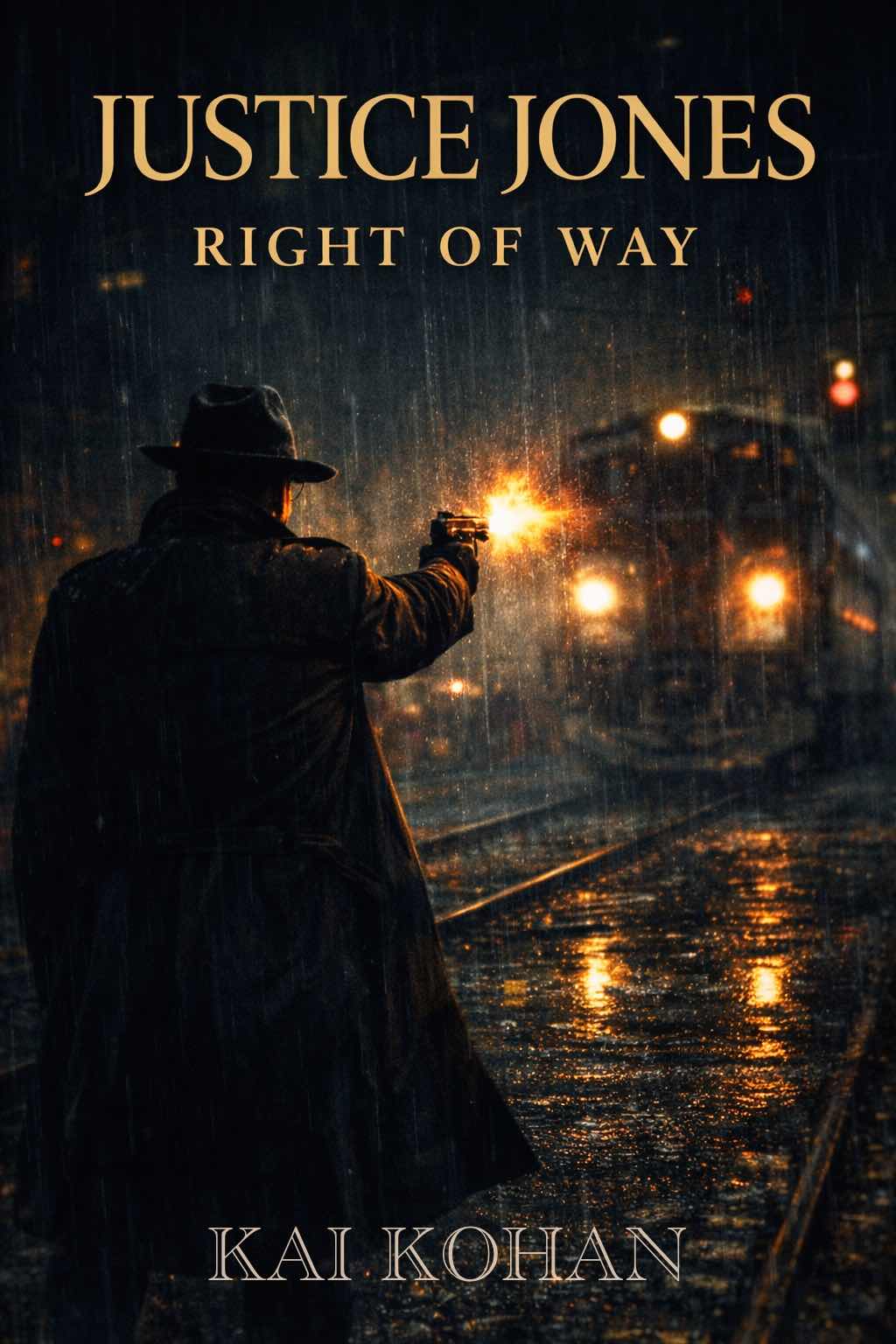
Right of Way
A controlled collision of authority, urgency, and access forces Justice to ask who gets to move freely—and who gets moved aside.
Buy on Amazon →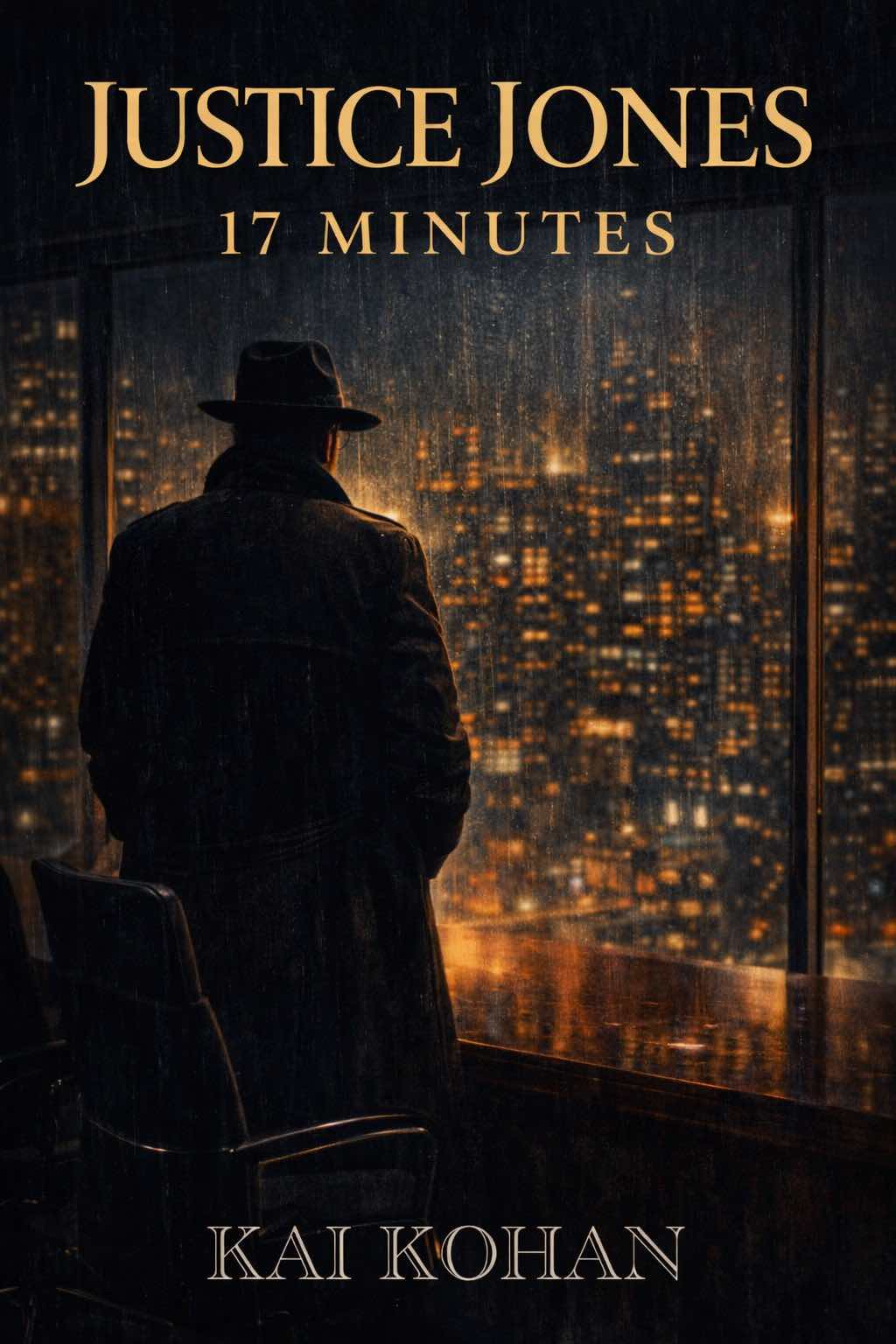
Seventeen Minutes
In a timeline that should be airtight, seventeen missing minutes are all it takes for the official story to crack.
Buy on Amazon →
Last Call
A late-night collapse, a closed room, and one final conversation no one wants on the record.
Buy on Amazon →Logline
A modern noir detective follows the gaps in official stories—missing records, misunderstood witnesses, sealed rooms, and erased timelines—exposing how institutions protect themselves when no one is supposed to notice.
The Question
What happens when justice is not hidden in a conspiracy, but buried in paperwork, procedure, impatience, and convenience?
Series Overview
Justice Jones is a case-file noir franchise about institutional silence. Each case appears contained, almost routine, until Justice notices what everyone else has accepted too quickly.
The series is built on precision: the missing line in a report, the witness no one slows down for, the room no one records, the minutes that disappear, and the final version of events that arrives too clean.
Across the literary series, Justice moves from police detective to private investigator, creating additional opportunities for character evolution and shifting conflicts on screen.
The detective. The machine. The truth.
Justice Jones brings classic investigative instincts into a world increasingly defined by data, automation, and institutions that mistake information for understanding.
Justice Jones
A Black detective whose greatest strength isn’t intimidation or spectacle. It’s his refusal to overlook the detail everyone else dismisses.
Justice listens carefully, distrusts tidy explanations, and understands that the absence of evidence can itself be revealing.
His transition from police detective to private investigator also changes his relationship with authority: first working within institutions, then confronting them from outside.
An Unusual Partnership
An artificial-intelligence companion introduces another perspective on evidence, patterns, contradictions, and competing interpretations.
Technology can process information at extraordinary speed. Justice brings context, judgment, empathy, and the capacity to recognize when a technically correct answer misses the human truth.
Their relationship creates opportunities for tension, dry humor, trust, and evolving dependence, without transforming the series into futuristic science fiction.
One franchise. Multiple screen pathways.
The six-episode season is our initial development proposal, not a restriction on how the property may ultimately be adapted.
Six-Episode Season
Six literary investigations developed into a compact, character-led first season with episodic closure.
Extended Crime Series
Individual investigations expand across multiple episodes, with continuing character and institutional arcs.
Standalone Features
Selected novels adapted as self-contained detective thrillers with a recurring lead character.
International Development
Screenplay collaboration, production partnerships, creative packaging, and compatible co-production models.
The Deep Deck
For producers, filmmakers, readers, publishing partners, and franchise-minded troublemakers who want to examine the architecture underneath the cases.
Format & Franchise Specifications
Title: Justice Jones
Franchise: Kohan & Phillips
Original Creator: Kamary Phillips
Novels By: Kai Kohan
Screen Development Contact: Craig Phillips · Port City Productions
Underlying IP: Six published novels
Literary Format: Modern noir detective fiction
Genre: Crime · Mystery · Institutional thriller
Case Structure: Standalone mysteries with thematic continuity
Initial Screen Proposition: Six-episode first season
Additional Screen Potential: Expanded television arcs, serialized procedural, limited series, or standalone films
Screen Development: Concept stage; scripts and production structure subject to development
Tone & Visual Style
- Restrained, atmospheric, precise.
- Noir without cartoon darkness.
- Modern institutional spaces: records rooms, corridors, sealed offices, apartments, civic buildings.
- Quiet dread instead of loud spectacle.
- Consequences that arrive late, clean, and devastating.
- Visual motifs: missing pages, empty rooms, fluorescent silence, glass partitions, closed files, clock gaps.
- A contemporary visual world that remains grounded rather than futuristic.
The Justice Jones Method
Justice does not begin by assuming conspiracy. He begins by refusing to accept the first neat version of a story.
- He listens where others summarize.
- He follows absence as evidence.
- He reads procedure as character.
- He understands that institutions rarely confess; they file, delay, reclassify, and move on.
- He distinguishes what can be documented from what can actually be understood.
Character Evolution: Detective to Private Investigator
The first three novels position Justice within his detective career, where procedure, hierarchy, and official authority shape the investigations.
The following three novels move into his private-investigator era. The change allows the screen version to explore a protagonist who increasingly questions the institutions he once represented.
This evolution can be incorporated into the first-season structure or developed more gradually across an expanded television adaptation.
The AI Companion
Justice’s artificial-intelligence companion offers a contemporary investigative dimension without displacing the central human drama.
The relationship can explore the limits of machine-generated interpretations, the need for human judgment, and the tension between statistical patterns and moral understanding.
The AI element is intended as a character and storytelling opportunity, not a requirement for elaborate science-fiction world-building.
Case Pattern
Each case begins with a conclusion that appears already resolved: a closed file, a confused witness, a room without records, a traffic decision, an airtight timeline, or a late-night collapse.
Justice pulls on the smallest inconsistency until the official story becomes less solid than everyone insisted.
Screen Adaptation Strategy
The initial proposed model is a six-episode first season derived from the six existing novels.
That approach provides a clearly defined development proposition for television producers while retaining flexibility to expand individual cases.
Depending on the creative partner, selected stories could instead become multi-episode investigations, feature-length television mysteries, or standalone theatrical films.
Final adaptation decisions would be developed collaboratively with the appropriate producing and screenwriting partners.
Audience & Positioning
- For audiences who enjoy investigative crime drama with restraint and atmosphere.
- For viewers drawn to institutional mystery and morally complex characters.
- For readers and viewers who prefer precision over spectacle.
- For contemporary noir audiences interested in technology, bureaucracy, and the changing nature of evidence.
- For international television markets seeking recognizable procedural foundations with distinctive characters.
Publishing & Audio Opportunities
The six published novels provide an established foundation for cross-platform promotion and screen-adaptation development.
Additional opportunities include audiobook development, serialized audio presentation, case-file promotional campaigns, character trailers, and screen-development materials.
The literary catalog is published through Audible Publishers within the wider Empire Media Company portfolio.
International Rights & Development Inquiries
Port City Productions welcomes introductory conversations with film and television producers, screenwriters, directors, development companies, and qualified international partners.
Potential areas of discussion include adaptation development, screen rights, screenplay collaboration, packaging, co-production, and distribution relationships.
Contact: Craig@PortCityProds.com
Established literary IP.
Open creative possibilities.
Port City Productions, an Empire Media Company LLC operation, is introducing Justice Jones to selected producers, filmmakers, and international development partners.
The six published novels establish the characters, investigations, and narrative world. The next opportunity is translating that foundation into compelling screen entertainment.
We’re interested in collaborating with partners whose experience in crime drama, mystery, and character-driven storytelling makes them a strong fit for the material.
We welcome discussion of adaptation strategy, creative development, screenwriting, project packaging, and potential production.
The case is never as closed as they say.
Six published novels. A proposed television adaptation. An established detective world ready for the next stage of creative development.
Port City Productions · An Empire Media Company LLC
Justice Jones · A Kohan & Phillips Franchise
Created by Kamary Phillips · Novels by Kai Kohan
Screen development inquiries: Craig Phillips · Craig@PortCityProds.com