House Rules
Three people. One house. No manual. A grounded family comedy about cohabitation, personality collision, chosen family, and the tiny domestic wars that reveal who people really are.
Structure meets chaos
His rules are survival armor. Her chaos is survival instinct. Levi watches both adults fail beautifully.
Lean and producible
One house, tight cast, strong blocking, visual callbacks, and dialogue-driven comedy built for agile production.
Chosen family
The point is not romance first. It is proximity, irritation, reluctant care, and the quiet shock of belonging.
Why this property plays
House Rules is lean, producible, relatable, and character-first — the kind of comedy that can start small, scale naturally, and travel because the emotional architecture is universal.
Clear core dynamic
He needs structure. She survives through instinct and humor. Levi observes everything. The comedy is baked into the living arrangement.
Lean production model
One primary location, minimal supporting cast, contained blocking, and performance-driven scenes make it ideal for agile production.
Modern family relevance
Cohabitation, economic pressure, unconventional households, and chosen family are not fringe ideas — they are normal life now.
Expandable IP
The concept works as scripted series, digital shorts, publishing adaptation, social clips, or proof-of-concept production.
The core dynamic
Comedy arises from personality collision, not punchlines.
The Rule Maker
Precise. Pedantic. Emotionally guarded. Lives by sticky notes, routines, identical wardrobe pieces, and the desperate belief that structure creates stability.
He is not cold. He is defended.
The Chaos Manager
Playful, instinctive, overextended, sharp, and allergic to pretension. She mocks what she secretly finds intriguing and laughs because stopping would mean collapsing.
She is not messy. She is surviving.
The Observer
Funny, emotionally intelligent, and usually aligned with his mother — until he isn’t. Levi sees through both adults and occasionally enjoys watching the collision.
He is not a sidekick. He is the truth detector.
Pilot — “Move-In”
The series begins with boxes, sticky notes, identical shirts, an unstable home office, and three people pretending this arrangement is temporary.
Pilot story
He arrives with structured luggage and identical wardrobe pieces. She mocks. Levi piles on. He posts house rules in sticky-note form.
Mid-chaos, her remote work system crashes. He fixes it calmly, then awkwardly hovers. Later, she quietly adds to one of his notes: “Or just call you?”
He does not notice for days. End beat: subtle shift, not romance.
The pilot promise: the house is not magically fixed. Nobody becomes better overnight. But something in the room changes.
Season one arc
- He arrives rigid and insulated.
- She mocks. Levi observes.
- His competence is revealed before his softness is.
- He attempts humor badly, then less badly.
- The sticky notes subtly deteriorate under stress.
- No romance yet — just proximity, tension, and reluctant respect.
- Season ends with him choosing to stay because he is less alone.
Format & visual language
Smart, observational, emotionally restrained, family-accessible, adult-relatable.
The Sticky Note System
His coping mechanism is visible: neat when stable, crooked when stressed, absent when emotionally overwhelmed.
A recurring visual language that tracks growth without exposition.
Production model
Designed for agile production: one primary location, minimal supporting cast, high-resolution mobile cinema, static framing, post-production reframing, and performance-driven blocking.
Tone & runtime
Single-camera realism. Dialogue-driven. Performance-first. Eighteen to twenty-four minute episodes with visual callbacks, spatial blocking, and domestic pressure.
The published version
House Rules also exists as a published Audible Publishers title, giving the concept a book-side footprint while the screen version remains cleanly producible.
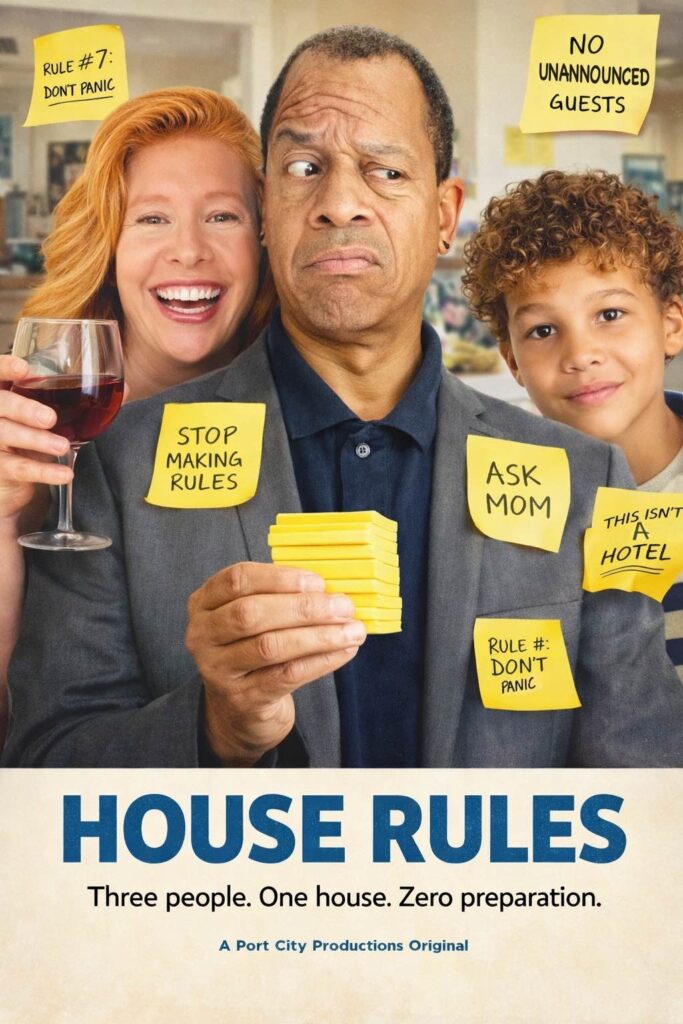
House Rules
Three mismatched personalities are forced into shared domestic space: one rigid, one chaotic, one observant. Structure meets survival, and neither wins quietly.
The will-they-won’t-they tension exists, but it does not lead the show. The real engine is the slow evolution from temporary cohabitation to chosen family.
Why this works now
Modern families are unconventional. Cohabitation is common. Chosen family is normal.
Long-term story engine
- His failing publishing ambitions
- Her romantic misfires
- Financial strain in future seasons
- Levi’s shifting loyalty
- The slow evolution from cohabitation to chosen family
- Mockery as intimacy
Port City strategy
This is scalable, creator-owned IP: produced lean, owned fully, controlled creatively, and expandable across scripted series, digital shorts, publishing adaptations, and cross-media development.
Translation: built locally, designed to travel. Low overhead. High character return.
Three people. One house. No manual.
House Rules is a lean, character-first family comedy with a strong domestic engine, modern relevance, and clear production practicality. It is small enough to make and sturdy enough to grow.